
Portable Air Conditioner Running Costs Australia
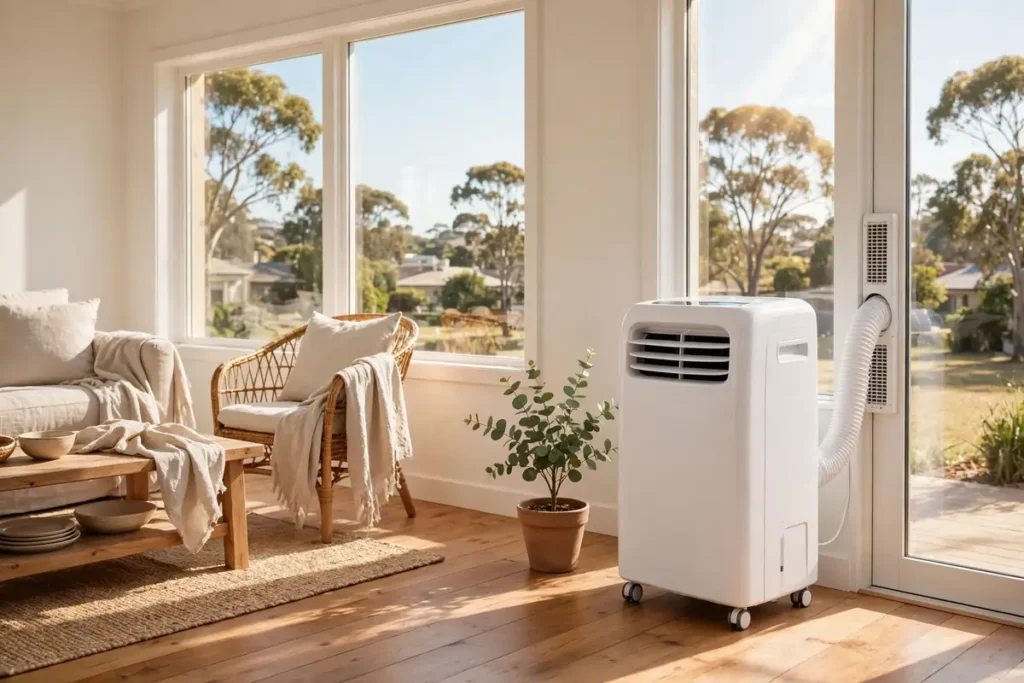
If you are trying to work out what portable air conditioner running costs Australia households actually pay, the honest answer is that it depends on two things: the model you run and the state you run it in. The same unit can cost about 60% more over a summer in South Australia than it does in Victoria, simply because the electricity price is different. This guide prices five portable air conditioners already covered in our best portable air conditioner Australia 2026 guide, model by model, at the 2026–27 reference tariff in each of New South Wales, Victoria, Queensland, South Australia and Western Australia. Every figure below is worked from the model’s rated input power and the state’s flat-rate reference price, so you can check the maths yourself and re-price any other model with the same formula.
The five models are the De’Longhi Pinguino PACEM82K, the Goldair GPPAC300, the Dimplex DCP9C, the Kogan SmarterHome 3.5kW (KAWFPAC12YA) and the Hyundai 2.9kW Smart. This article answers one question only: what does each one cost to run?
How the maths works
The formula is simple, and it is the same one every running-costs calculator uses:
Hourly cost = rated input power (kW) × your tariff ($/kWh)
A day’s cost is the hourly cost multiplied by the hours you run it, and a summer total is the daily cost multiplied by 90 days. We use an 8-hour day and a 90-day summer throughout, so every number in this guide is directly comparable.
Take the De’Longhi in New South Wales: it draws 0.99 kW and the NSW reference tariff is 33.14c/kWh. Hourly: 0.99 × $0.3314 = $0.33. Over 8 hours that is 7.92 kWh, or $2.62, and over 90 days $236. The same steps produce every figure below.
Please read this before using the tables. Costs below use each state’s flat-rate reference price (DMO / VDO / Synergy, 2026–27, GST-inclusive, usage charge only). They assume the compressor runs at its rated input power for the full period (100% duty cycle). In real use the compressor cycles off once the room reaches temperature, so real costs are usually lower. Your actual rate depends on your network and plan; most market offers sit below these reference prices. The daily supply charge is not included, because it is a fixed charge you pay whether the air conditioner runs or not. These are reference figures for comparison, not a quote of what you will pay.
The five models at a glance
Running cost follows input power, not the size of the box. What matters is how many watts the unit draws for each kilowatt of cooling it delivers. The Goldair and the Dimplex both draw 1.30 kW, yet the Goldair cools 3.5 kW against the Dimplex’s 2.6 kW, so it gives you more cooling for the same electricity.
| Model | Cooling capacity | Rated input power (cooling) | Cooling per kW drawn |
|---|---|---|---|
| De’Longhi Pinguino PACEM82K | 2.4 kW | 0.99 kW | 2.42 |
| Goldair GPPAC300 | 3.5 kW | 1.30 kW | 2.72 |
| Dimplex DCP9C | 2.6 kW | 1.30 kW | 2.00 |
| Kogan SmarterHome 3.5kW (KAWFPAC12YA) | 3.5 kW | 1.40 kW | 2.50 |
| Hyundai 2.9kW Smart | 2.9 kW | 1.15 kW | 2.52 |
Two notes on the specs. The De’Longhi manual lists 1,000 W while the Australian listing for the exact PACEM82K model says 990 W; we used 0.99 kW, and the 10 W difference is about 1% either way. The Kogan figure of 1.40 kW is verified for the KAWFPAC12YA variant only, from Kogan’s own manual. The Hyundai manual lists both a standard-rating input of 1,115 W and a rated input of 1,150 W; we used the rated 1.15 kW, keeping all five models on the same rated-input basis. All figures are for cooling only.
Portable air conditioner running costs Australia: the five models, costed by state
Tariffs are the 2026–27 flat-rate reference prices, GST-inclusive: NSW 33.14c, VIC 25.96c, QLD 27.97c, SA 41.91c and WA 33.26c per kWh. NSW uses the Ausgrid figure, Victoria the CitiPower figure and Queensland the Energex (South East Queensland) figure. No state has a single tariff: NSW runs 33.14–35.01c by network, Victoria 25.96–31.98c, and regional Queensland on Ergon Tariff 11 is 28.89c. If you are outside Sydney or inner Melbourne, your figure sits inside those ranges, so treat the tables as a like-for-like comparison, not a bill forecast.
De’Longhi Pinguino PACEM82K — 0.99 kW input
The cheapest to run in straight dollars, because it draws under a kilowatt: $185 a summer in Victoria, $299 in South Australia.
| State | Tariff (c/kWh) | Per hour | 8-hour day | 90-day summer |
|---|---|---|---|---|
| NSW | 33.14 | $0.33 | $2.62 | $236 |
| VIC | 25.96 | $0.26 | $2.06 | $185 |
| QLD | 27.97 | $0.28 | $2.22 | $199 |
| SA | 41.91 | $0.41 | $3.32 | $299 |
| WA | 33.26 | $0.33 | $2.63 | $237 |
Goldair GPPAC300 — 1.30 kW input
Same power draw as the Dimplex, but it cools a larger space — which is why it leads the value ranking below, even though its dollar figures match the Dimplex line for line.
| State | Tariff (c/kWh) | Per hour | 8-hour day | 90-day summer |
|---|---|---|---|---|
| NSW | 33.14 | $0.43 | $3.45 | $310 |
| VIC | 25.96 | $0.34 | $2.70 | $243 |
| QLD | 27.97 | $0.36 | $2.91 | $262 |
| SA | 41.91 | $0.54 | $4.36 | $392 |
| WA | 33.26 | $0.43 | $3.46 | $311 |
Dimplex DCP9C — 1.30 kW input
Identical running costs to the Goldair, because both draw 1.30 kW. The difference is cooling output: 2.6 kW against the Goldair’s 3.5 kW, so less cooling for the same spend.
| State | Tariff (c/kWh) | Per hour | 8-hour day | 90-day summer |
|---|---|---|---|---|
| NSW | 33.14 | $0.43 | $3.45 | $310 |
| VIC | 25.96 | $0.34 | $2.70 | $243 |
| QLD | 27.97 | $0.36 | $2.91 | $262 |
| SA | 41.91 | $0.54 | $4.36 | $392 |
| WA | 33.26 | $0.43 | $3.46 | $311 |
Kogan SmarterHome 3.5kW (KAWFPAC12YA) — 1.40 kW input
The highest input power here, and the most expensive to run in every state: $0.59 an hour and $422 a summer in South Australia.
| State | Tariff (c/kWh) | Per hour | 8-hour day | 90-day summer |
|---|---|---|---|---|
| NSW | 33.14 | $0.46 | $3.71 | $334 |
| VIC | 25.96 | $0.36 | $2.91 | $262 |
| QLD | 27.97 | $0.39 | $3.13 | $282 |
| SA | 41.91 | $0.59 | $4.69 | $422 |
| WA | 33.26 | $0.47 | $3.73 | $335 |
Hyundai 2.9kW Smart — 1.15 kW input
Mid-pack on input power and on cost: $215 a summer in Victoria, $347 in South Australia.
| State | Tariff (c/kWh) | Per hour | 8-hour day | 90-day summer |
|---|---|---|---|---|
| NSW | 33.14 | $0.38 | $3.05 | $274 |
| VIC | 25.96 | $0.30 | $2.39 | $215 |
| QLD | 27.97 | $0.32 | $2.57 | $232 |
| SA | 41.91 | $0.48 | $3.86 | $347 |
| WA | 33.26 | $0.38 | $3.06 | $275 |
Reading the numbers state by state
Victoria is the cheapest state in this guide and South Australia the dearest, by a wide margin. The South Australian reference tariff of 41.91c is about 61% higher than Victoria’s 25.96c, so the same unit, run for the same hours, costs about 61% more in Adelaide than in Melbourne. The Kogan, for example, costs $262 over a summer in Victoria and $422 in South Australia. That gap is the single biggest factor in this whole guide, bigger than the difference between any two models.
New South Wales and Western Australia sit close together at 33.14c and 33.26c, so their columns are nearly identical — the De’Longhi costs $236 a summer in NSW and $237 in WA. Queensland sits between Victoria and NSW at 27.97c; regional Queenslanders on Ergon Tariff 11 at 28.89c pay a touch more.
Within a state, the spread between models is real but smaller than the spread between states. In NSW the cheapest summer is the De’Longhi at $236 and the dearest is the Kogan at $334, a gap of $98; in South Australia the same two models are $299 and $422, a gap of $123. Choosing the lower-draw model saves roughly $100 a summer at NSW prices.
Hourly figures look small and summer figures do not. Thirty-three cents an hour sounds like nothing; $236 over a summer is the same number, and the one worth budgeting for. Run the unit 4 hours a day instead of 8 and halve every summer figure; run it 12 hours and multiply by one and a half. Those are the portable air conditioner running costs Australia households face at the reference tariffs — your own bill depends on your plan.
Portable air conditioner running costs Australia: cheapest to run per kW of cooling
Dollar totals alone do not tell you which model gives you the most cooling for your money, because the models cool different-sized rooms. The fair comparison is cost per kilowatt of cooling: input power divided by cooling capacity, multiplied by the tariff. Ranked at the NSW reference tariff of 33.14c, the order is:
| Rank | Model | Cost per hour, per kW of cooling | 90-day summer cost per kW of cooling |
|---|---|---|---|
| 1 | Goldair GPPAC300 | $0.12 | $88 |
| 2 | Hyundai 2.9kW Smart | $0.13 | $95 |
| 3 | Kogan SmarterHome 3.5kW (KAWFPAC12YA) | $0.13 | $95 |
| 4 | De’Longhi Pinguino PACEM82K | $0.14 | $98 |
| 5 | Dimplex DCP9C | $0.17 | $119 |
The Goldair leads because it pairs a 1.30 kW draw with the largest cooling capacity here, 3.5 kW. The Hyundai and the Kogan are effectively tied in second and third: the Hyundai draws less power for less cooling, the Kogan draws more for more, and the ratio comes out nearly the same. The De’Longhi is cheapest in absolute dollars but cools the smallest space at 2.4 kW, so it sits fourth per kilowatt of cooling. The Dimplex is last by a clear gap, $0.17 an hour per kilowatt of cooling against $0.12 for the Goldair, because it draws the same 1.30 kW while cooling only 2.6 kW.
Keep the ranking in perspective: it measures running cost per unit of cooling, not comfort, noise, features or purchase price. A model that is cheap to run per kilowatt is no use if it is too small for your room. Use this ranking alongside the buying guide, not instead of it.
How to keep the bill down
Every figure in this guide assumes the compressor runs flat out for the full period. In practice it does not: once the room reaches the temperature you set, the compressor cycles off and the unit draws far less power until the room warms up again. Three habits make that cycle work in your favour, and they are the cheapest way to cut portable air conditioner running costs Australia households pay each summer.
First, set the thermostat sensibly. Cooling a room to 22°C costs noticeably more than cooling it to 25°C or 26°C, because the compressor has further to go and stays on longer to hold the lower temperature. A setting around 25–26°C is comfortable for most people on a hot day and keeps the compressor cycling rather than running non-stop.
Second, vent the hot air properly. If the exhaust hose is loose, kinked or venting back into the room, the unit works harder for the same result. Fit the window kit, keep the hose short and straight, and close the doors and windows of the room you are cooling so the cold air stays where you want it.
Third, use the timer and the fan. Running the unit for an hour before bed and letting the timer switch it off beats leaving it on all night, and on warm rather than hot days fan-only mode moves air without running the compressor at all. A clean filter helps too: a clogged filter makes the unit work harder, so check it a few times over summer.
Buy now or wait?
Summer is the worst time to discover you need a portable air conditioner, and the best time to be using one. If your room needs cooling now, the running costs above are the numbers to budget on, and a lower-draw model will pay back a little of its purchase price every summer it runs.
If you can wait, Black Friday falls on 27 November 2026, and portable air conditioners often appear in seasonal sales. We have not seen any specific deal for these five models and we are not claiming one exists. The purchase prices we verified on 5 November 2026 are single-retailer snapshots, and prices move, so check the current price at more than one retailer before you buy, and check our deals hub for anything we have verified. A sale price changes the purchase cost, not the running cost: the tables above stay the same whatever you paid for the unit.
What the models cost to buy
Running cost is only half the picture, so here is what we could verify about purchase prices on 5 November 2026. Two prices come from a single live retailer source each, and we label them as such. The other three models have no current purchase price we could verify, and we would rather say so than print a stale figure.
- De’Longhi Pinguino PACEM82K — $849, single source: The Good Guys, live page checked 5 November 2026, listed as in stock.
- Dimplex DCP9C — $699, single source: The Good Guys, live page checked 5 November 2026, listed as in stock.
- Goldair GPPAC300 — no current price verified. No Australian retailer listing was found on 5 November 2026, and the October 2026 figures from our buying guide could not be re-verified, so we are not repeating them as current.
- Kogan SmarterHome 3.5kW — no current price verified. The model is listed on kogan.com, but the dollar price is member-gated and was not readable. Older prices found online are stale and conflicting, so we are not quoting them.
- Hyundai 2.9kW Smart — availability unconfirmed, no current price. The model did not appear in Kogan’s portable air conditioner category listing checked on 4 November 2026. That is a warning sign, not proof it has been discontinued, but check availability before buying rather than assuming it is on sale.
We did not present any single-source price as a market average or a range, and we did not carry the October 2026 prices from the buying guide forward as current. If you are comparing purchase prices, verify them live at the retailer before you buy.
Methodology, exclusions and gaps
Input powers come from the manufacturers’ own spec sheets and manuals: the De’Longhi Australian listing (990 W), the Goldair operating manual (1,300 W), the official Dimplex spec sheet (1,300 W), the official Kogan manual for the KAWFPAC12YA (1,400 W) and the Hyundai manual (1,150 W rated input). Tariffs come from the Australian Energy Regulator’s Default Market Offer 2026–27 information kit, the Victorian Default Offer 2026–27 and Synergy’s Home Plan A1 — GST-inclusive flat-rate usage charges effective 1 July 2026 to 30 June 2027. Canstar’s published averages for the same networks sit just below these caps, as expected for market-offer averages, and line up with the figures used here.
What this guide leaves out is deliberate. It excludes the daily supply charge, which does not change with air conditioner use, and time-of-use tariffs, which would need a separate column for every time band. It does not cover heating costs, ducted or split systems, or the Northern Territory, Tasmania and the ACT, where different tariffs apply. And it does not use the generic bands some guides quote, such as 1.0–2.5 kWh an hour or 30–60 cents an hour — those are national averages, not per-model figures.
The gaps, stated plainly: three of the five models have no verified current purchase price, and the Hyundai’s availability is unconfirmed. Both live purchase prices are single-source. The NSW and Victorian figures are largest-network references with the full state ranges footnoted, not a figure for every reader. And only about 8% of households in DMO regions are on standing offers; most people on market offers pay less than the reference prices here, so your bill is likely lower than these tables suggest.
Disclosure: ItsReleased currently earns no commissions from links in this article. Our affiliate and advertising disclosure explains how that works. Browse all our product guides on the launches index.
Frequently asked questions
How much does a portable air conditioner cost to run per hour in Australia?
At the 2026–27 reference tariffs, the five models in this guide cost between 26 cents an hour (De’Longhi Pinguino PACEM82K in Victoria at 25.96c/kWh) and 59 cents an hour (Kogan SmarterHome 3.5kW in South Australia at 41.91c/kWh). In New South Wales the range is 33 to 46 cents an hour. Your own rate depends on your network and plan, and most market offers sit below the reference prices used here.
Which portable air conditioner is cheapest to run in Australia?
In straight dollars, the De’Longhi Pinguino PACEM82K is cheapest, because it draws only 0.99 kW: 33 cents an hour in NSW and $236 over a 90-day summer. Per kilowatt of cooling, the Goldair GPPAC300 is cheapest at $0.12 an hour per kW of cooling at the NSW tariff, ahead of the Hyundai and Kogan at $0.13, the De’Longhi at $0.14 and the Dimplex at $0.17. Which one is “cheapest” for you depends on the size of the room you need to cool.
How much does it cost to run a portable air conditioner all summer in Australia?
Running 8 hours a day for 90 days at the 2026–27 reference tariffs, the five models cost between $185 (De’Longhi in Victoria) and $422 (Kogan in South Australia) for the summer. In New South Wales the range is $236 to $334. These figures assume the compressor runs at full rated power the whole time; in practice it cycles off once the room reaches temperature, so real summer costs are usually lower.
Why does the same portable air conditioner cost more to run in South Australia?
Because the electricity price is higher. The South Australian reference tariff is 41.91c per kWh against 25.96c in Victoria, about 61% more, so the same unit run for the same hours costs about 61% more. The tariff is set by your network and the Default Market Offer for your region, not by the air conditioner. If you are on a market offer rather than the standing offer, your rate is likely to be below the reference price used in this guide.
Do portable air conditioners cost more to run than split systems?
Yes, in general. CHOICE’s testing put a portable air conditioner at $172 over a summer against $61 for a small split system, running 4 hours a day for 90 days at 40c/kWh. Portables draw more power for the cooling they deliver, and they vent hot air through a hose in the room they are cooling. A split system costs more to install but is the cheaper option to run, which is why a portable makes most sense where a split system cannot be installed, such as a rental.

Related Launches

Discussion
💬 Members are talking about this launch.
Sign in to join the discussion and share your take.