
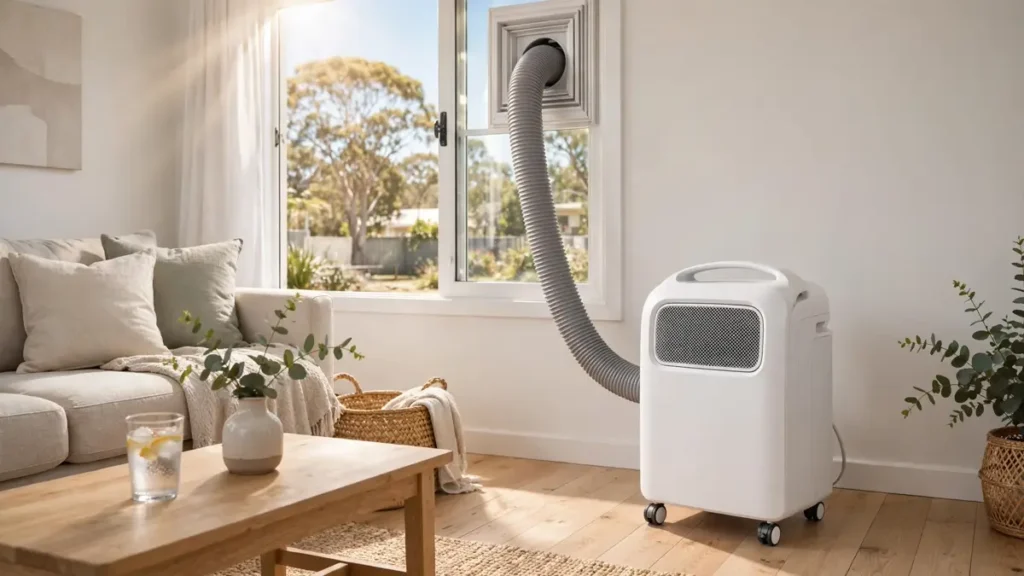
There’s a particular kind of Australian summer afternoon that no ceiling fan can fix. The air goes thick by 2pm, the bedroom holds the heat until midnight, and if you’re renting, a split system is out of the question. That’s exactly the moment a portable air conditioner earns its keep — no installation, no tradie, no landlord approval. Just roll it in, run the exhaust hose to a window, and switch it on.
But here’s the problem: portable air conditioners vary wildly. Some genuinely cool a bedroom down by 6–8 degrees. Others are little more than noisy dehumidifiers that disappoint on the first 38-degree day. We researched the portable ACs actually on sale in Australia right now, checked real prices across major Australian retailers in October 2026, and picked five that are worth your money — one for every budget and room size.
Every price below was verified live on 14 October 2026. Read how we verify every price before we publish.
How We Chose the Best Portable Air Conditioners
A portable air conditioner is only as good as the match between its capacity and your room. These are the five things we checked on every unit before it made the list:
1. Cooling capacity (kW) vs your room size
Forget marketing claims — the honest number is cooling capacity in kilowatts (kW), with BTU as a rough companion. A unit that can genuinely cool 20m² will do nothing for an open-plan living area. Every pick below lists its stated capacity and the room size it suits. Undersizing is the number one mistake: an underpowered unit runs flat-out all day, never reaches temperature, and costs you a fortune to run.
2. Noise (dB)
All portable air conditioners make noise — the compressor sits in your room, not outside like a split system. We publish the stated noise level where the manufacturer provides one. As a guide: under 50dB is genuinely quiet for this category, 50–55dB is average, and anything above that will be hard to sleep next to.
3. Energy efficiency and running cost
Portable air conditioners are less efficient than split systems, full stop. We looked at input power (the watts the unit actually draws) and published efficiency figures like EER or energy class, because a “cheap” $319 unit can cost you more over one summer than a $799 one if it guzzles power.
4. Window kit and venting
Every portable air conditioner must exhaust hot air outside — usually through a window. A good included window kit (plus a hose long enough to reach) is the difference between a 15-minute setup and a weekend of DIY frustration. Every unit on this list includes a window kit.
5. Dehumidification and drainage
Modern portables mostly use self-evaporative systems that recycle condensed moisture, so you rarely need to empty a tank. Units without this need regular draining. We flag which is which.
1. De’Longhi Pinguino PACEM82K Silent — Best Overall Portable AC
If you want the quietest, best-built portable air conditioner you can buy in Australia in 2026, the De’Longhi Pinguino PACEM82K is the one. De’Longhi has been refining the Pinguino line for years, and it shows in the details: noise pressure of just 47–50dB(A), an energy efficiency class of A, and eco-friendly R290 refrigerant.
With 2.4kW of cooling (9,400 BTU/h), it’s sized for rooms up to 80m³ — roughly a large bedroom or small living area. The three fan speeds, 24-hour timer, remote control and built-in dehumidifier (43 litres per day) cover everything most households need. The window kit, castors and handles come included, and at 31.5kg it’s one of the heavier units here — but you only move it seasonally, not daily.
What we like: class-leading quietness (47–50dB); Class A energy efficiency; R290 refrigerant; strong dehumidifying; 2-year warranty; Italian design that doesn’t look like industrial equipment.
What to know: 2.4kW won’t cool a large open-plan space; the 1.25m exhaust hose is on the shorter side, so check your window distance; it’s the priciest pick on this list.
Price checked 14 October 2026: $799 at Betta (in stock; also listed around $849 at other retailers).
2. Goldair 3.5kW Multi-Season Hot & Cold (GPPAC300) — Best for Large Rooms
Need the most raw cooling power? The Goldair GPPAC300 delivers 3.53kW of cooling — 12,000 BTU/h — which is the most muscle on this list, and it does it with a trick the others can’t: reverse-cycle heating. This is genuinely an all-year appliance, cooling you through summer and warming you through winter.
Beyond the headline numbers, it’s well equipped: 2.7kW of heating power, 28 litres per day of dehumidification, Wi-Fi with the Goldair app, and voice control through Google Assistant and Alexa. The self-evaporating system means minimal draining, sleep mode keeps nights bearable, and the window kit is included. A remote, three fan speeds and an auto-swinging louvre round it out.
What we like: most cooling power of any unit here (3.53kW); heating for winter — genuinely year-round; Wi-Fi and voice control; self-evaporating drainage; remote and timer.
What to know: Goldair doesn’t publish a noise figure, so assume average-to-loud for this category; it’s a big, heavy unit (this is the nature of 3.5kW portables); price varies between retailers, so compare before buying.
Price checked 14 October 2026: $748 at Joyce Mayne (in stock); $849 at Harvey Norman. Shop around — the gap is real.
3. Dimplex 2.6kW Portable AC (DCP9C) — Best for Bedrooms
Dimplex is one of the most trusted names in Australian home heating and cooling, and the DCP9C is its sensible, no-nonsense portable. With 2.6kW of cooling for rooms up to 20m², it’s sized exactly right for the average Australian bedroom — which is where most portable ACs actually live.
The stated noise level is 54dBA: not the quietest on this list, but honest and about average for the category — owners at The Good Guys rate it 4.2 out of 5 from 20 reviews, noting it cools small rooms quickly and is easy to set up. You get touch controls, a 24-hour timer, a thermostat range of 17–30°C, two fan speeds, a remote, and a window kit. The built-in dehumidifier pulls 0.54 litres of moisture per hour, which matters on humid coastal nights.
What we like: perfect sizing for bedrooms (up to 20m²); honest 54dB noise rating; compact footprint at just 20.8kg; 2-year manufacturer’s warranty; strong owner reviews at The Good Guys.
What to know: 54dB will be noticeable overnight in a small room — light sleepers should run it on a timer before bed instead; the window kit gets some criticism for short plates on sliding windows.
Price checked 14 October 2026: $699 at The Good Guys (in stock, 4.2/5 from 20 reviews); also $699 at Betta.
4. Kogan SmarterHome 3.5kW Portable (12,000 BTU) — Best Value
Here’s the surprise of the list: Kogan’s own SmarterHome 3.5kW portable matches the Goldair’s cooling power — 3.5kW, 12,000 BTU, rooms up to 22m² — for roughly half the price. If your priority is cooling capacity per dollar, nothing else in Australia comes close in October 2026.
It’s not stripped back, either. You get a 3-in-1 cooling, dehumidifying and fan-only system, app control through the Kogan SmarterHome app, Alexa and Google Assistant voice control, a 16–30°C temperature range, auto-swing airflow, a programmable timer and a self-evaporating system that keeps maintenance low. Castor wheels make it easy to roll between rooms.
What we like: 3.5kW of cooling for under $400 — unmatched value; full smart home integration; self-evaporating; Kogan-exclusive pricing undercuts every brand-name equivalent.
What to know: Kogan doesn’t publish a noise figure — budget for average portable noise; sold exclusively through Kogan.com; this is a sale price (SRP $799.99) and Kogan’s air-con sale ends 18 October 2026, so it may not last.
Price checked 14 October 2026: $389 at Kogan.com (Kogan-exclusive; SRP $799.99).
5. Hyundai 2.9kW Smart Portable (10,000 BTU) — Best Budget Pick
If the Kogan is the value king, the Hyundai 2.9kW is the cheapest way to get genuine, room-cooling performance in Australia right now. At $319, it’s the only pick on this list under $400 — and with 10,000 BTU/h of cooling for rooms of 15–20m², it’s properly sized for a bedroom or home office.
Despite the price, the spec sheet is respectable: 3-in-1 cooling, dehumidification and fan modes, a strong 340m³/h airflow, digital display, sleep mode, timer, remote control, and Alexa/Google Assistant smart control. Owners rate it 4.3 out of 5 from 101 reviews on Kogan. The self-evaporative system reduces energy waste and maintenance.
What we like: cheapest genuine portable AC on sale in Australia right now; 10,000 BTU is enough for a real bedroom; smart control at a budget price; 4.3/5 from over 100 owner reviews.
What to know: 2.9kW won’t handle a living room; no published noise figure; Hyundai appliances are sold through Kogan in Australia, so availability is Kogan-only; the current $319 price is a sale price off $799.99 SRP.
Price checked 14 October 2026: $319 at Kogan.com (in stock; Kogan-exclusive; SRP $799.99).
Quick Comparison: Best Portable Air Conditioners Australia 2026
| Model | Cooling | Room size | Noise | Heating | Window kit | Price (Oct 2026) |
|---|---|---|---|---|---|---|
| De’Longhi Pinguino PACEM82K | 2.4kW / 9,400 BTU | Up to 80m³ | 47–50dB | No | Yes | $799 (Betta) |
| Goldair GPPAC300 Multi-Season | 3.53kW / 12,000 BTU | Large rooms | Not published | Yes, 2.7kW | Yes | $748–$849 |
| Dimplex DCP9C | 2.6kW | Up to 20m² | 54dB | No | Yes | $699 |
| Kogan SmarterHome 3.5kW | 3.5kW / 12,000 BTU | Up to 22m² | Not published | No | Yes | $389 (Kogan) |
| Hyundai 2.9kW Smart | 2.9kW / 10,000 BTU | 15–20m² | Not published | No | Yes | $319 (Kogan) |
Buying Guide: How to Size a Portable Air Conditioner
BTU and kW vs room size (m²)
The single most important decision is capacity. Undersize and the unit runs all day without ever cooling the room; oversize and you pay more up front and cycle the compressor wastefully. Use this as a guide:
- Up to 15m² (small bedroom, study): 2.0–2.4kW / 7,000–9,000 BTU
- 15–20m² (standard bedroom, home office): 2.6–2.9kW / 9,000–10,000 BTU
- 20–25m² (master bedroom, small living area): 3.5kW / 12,000 BTU
- 25m²+ or open plan: portable units struggle — consider that no portable here exceeds 3.5kW. For genuinely large spaces, a split system is the honest recommendation.
Adjust upward if the room has high ceilings, big west-facing windows, poor insulation, or sits on the top floor of a brick unit — all common in Australian homes and all adding real heat load.
Venting: non-negotiable
Every portable air conditioner on this list — every portable on the market — must vent hot exhaust air outside. There is no ventless portable air conditioner; that’s physics, not marketing. All five picks include a window kit. Before you buy, check your window type: the included kits suit most sliding and sash windows, but unusually shaped or very tall windows may need a DIY extension (several Dimplex owners note the plates run short on sliding windows). Plan for at least 30cm of clearance behind the unit for the hose.
Running costs: the honest maths
Portable air conditioners draw roughly 1.0–1.4kW of electricity when the compressor is running (the De’Longhi PACEM82K, for example, lists 1,000W input power). A worked example, at a typical Australian tariff of around 35c/kWh:
1.0kW × 8 hours × $0.35 = $2.80 per day of continuous cooling.
Run it every afternoon for a three-month summer and you’re looking at roughly $250 in electricity — which is why efficiency matters. A unit with a higher EER or a Class A rating (like the De’Longhi) reaches temperature faster and cycles off sooner, costing less over the season than a cheaper, thirstier unit running flat-out. If you’re also chasing cleaner indoor air alongside cooling, our air purifiers guide covers the other half of summer comfort.
Frequently Asked Questions
How do I choose the right size portable air conditioner?
Match cooling capacity to room size: 2.0–2.4kW suits rooms up to 15m², 2.6–2.9kW suits 15–20m², and 3.5kW suits 20–25m². Size up if the room has high ceilings, large west-facing windows or poor insulation. An undersized unit will run constantly without ever reaching your set temperature.
Do portable air conditioners need a window?
Yes. Every portable air conditioner must exhaust hot air outside — there is no ventless portable AC. All five units on this list include a window kit for sliding or sash windows. You’ll also need a power point nearby and about 30cm of clearance behind the unit for the exhaust hose.
How much does a portable air conditioner cost to run?
A typical portable AC draws about 1.0–1.4kW while the compressor runs. At around 35c/kWh, that’s roughly $2.80 per day for 8 hours of continuous cooling, or about $250 over a three-month summer. More efficient units with higher EER ratings reach temperature faster and cost less to run.
Are portable air conditioners noisy?
Yes, relative to split systems — the compressor sits inside your room. Quiet models like the De’Longhi Pinguino run at 47–50dB, average units like the Dimplex DCP9C are rated at 54dB, and cheaper units can be louder. If you’re a light sleeper, use the timer to pre-cool the bedroom before bed rather than running it overnight.
Do portable air conditioners need draining?
Most modern portables use self-evaporative systems that recycle condensed moisture to cool the coils, so you rarely need to empty a tank. All five units on this list are self-evaporating or use condensate recycling. In very humid conditions you may still need occasional drainage — check the manual for your model’s drain plug location.
The Verdict
For most Australian households in 2026, the De’Longhi Pinguino PACEM82K ($799) is the best portable air conditioner: the quietest on the market, Class A efficiency, and build quality that justifies the premium. If you need maximum cooling or year-round use, the Goldair GPPAC300 ($748–$849) brings 3.53kW plus reverse-cycle heating.
But the honest value story this summer is Kogan: the Kogan SmarterHome 3.5kW at $389 matches the big brands’ cooling power for half the price, and the Hyundai 2.9kW at $319 is the cheapest genuine portable AC on sale in Australia right now. And for a trusted brand in a bedroom, the Dimplex DCP9C at $699 is the safe, well-reviewed middle ground.
All prices verified 14 October 2026 at the named Australian retailers. Prices and sale offers change — check before buying.