
Air Fryer Running Costs Australia: Per-Cook AUD 2026
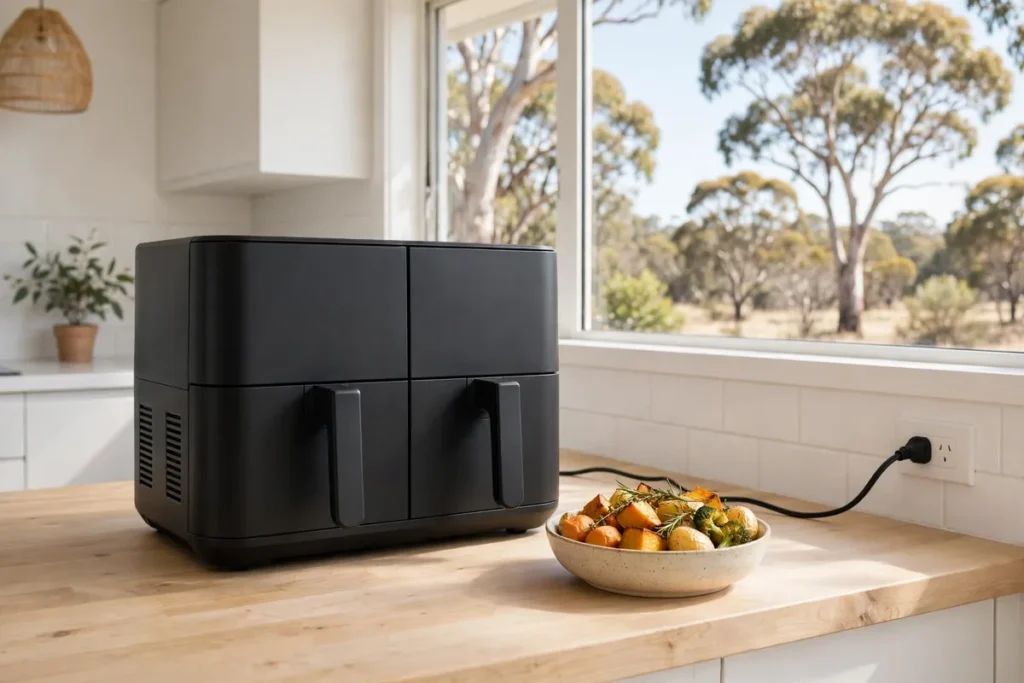
An air fryer costs very little to run — but “very little” is doing a lot of work in that sentence. The honest answer to air fryer running costs Australia is a number in cents, not a vibe: a typical 20-minute cook at full draw costs roughly 17 to 32 cents, depending on which model you own and which state you live in. The model matters less than most people think. The tariff matters more. And the saving against your oven, while real, is small enough that no air fryer ever pays for itself on electricity alone.
This guide works it out properly. We took four real models sold in Australia — the Ninja DoubleStack XXXL, the Philips 5000 Series steam fryer, the Tefal Ever Fry Flex 9L and the Ninja Crispi Pro — checked their wattages and their current street prices on 16 November 2026, and ran them against the actual 2026–27 electricity caps for each state, so it answers air fryer running costs Australia in cents per cook rather than in generalities. Every figure below shows its working, and every figure is a ceiling: real cooking costs less, because heating elements cycle on and off once the chamber is hot.
How the maths works
The formula has three parts, and only three. Take the model’s wattage, divide by 1,000 to get kilowatts, multiply by the hours it runs, then multiply by your tariff in cents per kilowatt-hour. That is the whole calculation — there is no secret ingredient, and any guide that will not show its working is asking you to trust a number it will not defend.
For a 20-minute cook, the energy is wattage divided by 3,000. A 2,000W fryer uses 0.667 kWh in 20 minutes. A 2,300W fryer uses 0.767 kWh. Multiply by your tariff — say 33.14 cents in Ausgrid’s Sydney area — and the 2,000W fryer costs 22.09 cents while the 2,300W fryer costs 25.41 cents. The 300W gap between the biggest and smallest fryer in this guide is worth about 3 cents a cook. Keep that number in mind, because it is the single most useful fact in this article: wattage differences between air fryers are nearly irrelevant to your bill. Cook time and your tariff decide almost everything.
Your tariff: what a kilowatt-hour costs in 2026–27
Australian electricity prices are capped by regulation, and the caps are the only honest anchor for a guide like this. The Australian Energy Regulator sets the Default Market Offer (DMO) for New South Wales, South-East Queensland and South Australia; Victoria has its own Victorian Default Offer (VDO) set by the Essential Services Commission. The figures below are the flat-rate usage caps for 1 July 2026 to 30 June 2027, GST included. They are caps on standing offers, not what most households pay — only about 8% of households sit on standing offers, and most people on market offers pay less. Time-of-use and off-peak rates can be lower still. So treat every cost in this guide as the top of the range, not the typical bill.
| Network / zone | Usage cap (c/kWh) |
|---|---|
| Energex (South-East Queensland) | 27.97 |
| Ausgrid (Sydney / NSW) | 33.14 |
| Endeavour Energy (NSW) | 33.73 |
| Essential Energy (regional NSW) | 35.01 |
| SA Power Networks (South Australia) | 41.91 |
| VDO — CitiPower (inner Melbourne) | 25.96 |
| VDO — AusNet Services (outer Melbourne / regional VIC) | 31.98 |
Two things stand out. First, the gap between the cheapest and dearest cap is wide: South Australia’s 41.91 cents is more than 60% above inner Melbourne’s 25.96 cents, so the same cook in Adelaide costs roughly half as much again as the same cook in Melbourne. In short, air fryer running costs Australia are set by your network’s cap first and your fryer’s wattage second. Second, these caps fell in most states this year — New South Wales flat rates dropped 3.4% to 5.0% and South-East Queensland dropped 7.2% against 2025–26 — which is why any guide still quoting a 2022 tariff of 22 cents, as one rival does, is understating today’s cost by about a third. Our numbers use the current caps, checked against the AER’s Default Market Offer information kit for 2026–27 and the Essential Services Commission’s Victorian Default Offer, and the per-kWh caps reproduce the regulator’s own annual DMO prices to within 50 cents when the daily supply charge is added back in. If your bill shows a lower usage rate than the cap, your real per-cook cost is lower than every figure below.
Air fryer running costs Australia: the 20-minute cook
Here is the table that matters. Each figure is the cost of one 20-minute cook with the element running at its rated wattage for the full 20 minutes — a ceiling, not a typical cook, because the element cycles once the chamber reaches temperature. The four models span the useful range: a 2,000W single basket, a 2,050W glass-container fryer, a 2,270W dual drawer and a 2,300W flex drawer.
| Model | Wattage | QLD (Energex 27.97c) | NSW (Ausgrid 33.14c) | SA (41.91c) | VIC (CitiPower 25.96c) |
|---|---|---|---|---|---|
| Philips 5000 Series NA547/07, 7.2L | 2,000W | 18.65c | 22.09c | 27.94c | 17.31c |
| Ninja Crispi Pro AS101ANZ | 2,050W | 19.12c | 22.64c | 28.64c | 17.74c |
| Ninja DoubleStack XXXL SL400ANZ, 9.5L | 2,270W | 21.17c | 25.07c | 31.71c | 19.64c |
| Tefal Ever Fry Infra Heat Flex EY9278, 9L | 2,300W | 21.45c | 25.41c | 32.13c | 19.90c |
Read the table across, not down. The cheapest cook in the country is the Philips in inner Melbourne at 17.31 cents; the dearest is the Tefal in South Australia at 32.13 cents. That is the full spread for a 20-minute cook: roughly 17 to 32 cents. Now read it down a column. In Sydney, the gap between the smallest fryer (Philips, 22.09c) and the biggest (Tefal, 25.41c) is 3.32 cents. In South Australia it is 4.19 cents. That is the price of choosing the more powerful model: three to four cents a cook. Over a year of cooking four times a week, the wattage gap between these four models is worth about $7. Nobody should pick an air fryer on wattage. Pick it on size, on whether you need two drawers, on whether you want glass containers instead of non-stick — and let the tariff do the talking on cost.
Two practical notes. Dual-zone models only draw their rated wattage with both zones running, so a single-drawer cook in the Ninja or a single-zone cook in the Tefal uses less than the table shows. And the Philips steam modes do not change its 2,000W maximum draw — steam adds moisture, not watts.
What the four example models cost to buy
Running costs only mean something next to the purchase price, so here are the current street prices, all checked live on 16 November 2026. Two of the four have only one fresh price each, and we say so plainly rather than inventing a range.
| Model | Wattage | Street price (16 Nov 2026) | Source |
|---|---|---|---|
| Philips 5000 Series NA547/07, 7.2L steam | 2,000W | $348 | The Good Guys, in stock (only fresh listing found; no Harvey Norman, Myer, JB Hi-Fi, Appliances Online or Bing Lee listing for this model) |
| Ninja Crispi Pro AS101ANZ (white) | 2,050W | $318 | The Good Guys, in stock (white/stone variant; RRP $499.99) |
| Ninja DoubleStack XXXL SL400ANZ (black) | 2,270W | $499 | The Good Guys, in stock (only fresh price; David Jones also shows $499 but from a stale August crawl. White variant SL400WH: $411 at Appliances Online) |
| Tefal Ever Fry Infra Heat Flex EY9278, 9L | 2,300W | $248–$249 | The Good Guys $248, Bing Lee $249, Harvey Norman $249, Joyce Mayne $249 — all in stock. RRP $349 |
The Tefal is the value story of the four: four retailers within a dollar of each other, and about $100 below its $349 RRP less than a month after launch. The Philips is the cheapest cook in the table and the second-cheapest to buy. The Ninja DoubleStack is the dearest at $499 — effectively its $499.99 list price, with no discount live. The Crispi Pro sits in the middle at $318 for the white model, well under its $499.99 RRP. For the full verdict on two of these models head to head, see our Ninja DoubleStack vs Philips 5000 comparison; for each model on its own, see the DoubleStack single, the Philips 5000 single and the Crispi Pro single. Our best air fryers roundup ranks the wider field, and our deals hub tracks price drops across all of them.
Air fryer vs oven: the honest saving
The question behind the question is whether an air fryer beats the oven you already own. The comparison needs the same honesty as the tables above: an oven is bigger, slower to heat, and runs longer. A standard Australian electric oven is rated between 2,000W and 3,500W, per EcoFlow’s Australian oven guide, and Australian appliance-cost tables use 2,400W as the standard figure — we use 2,400W as the worked assumption, and we say so rather than pretending it is a measured fact. A typical weeknight cook needs about 10 minutes of preheating plus 20 minutes of cooking, which is 30 minutes at the rated draw, or 1.2 kWh. At the same four tariffs, that oven cook costs 33.57 cents in South-East Queensland, 39.76 cents in Sydney, 50.29 cents in South Australia and 31.15 cents in inner Melbourne. Like the air fryer figures, that is a ceiling: ovens cycle too.
Against that, the saving per cook in Sydney is 17.67 cents for the Philips, 17.12 cents for the Crispi Pro, 14.69 cents for the Ninja DoubleStack and 14.36 cents for the Tefal. In South Australia, where electricity is dearest, the saving stretches to 22.35 cents for the Philips. In Victoria, where it is cheapest, it shrinks to 13.85 cents. So the air fryer wins every time — by roughly 14 to 22 cents a cook, depending on model and state. It is a real saving, and it is also a small one. A household cooking four times a week saves about $30 to $37 a year in Sydney. That is a takeaway coffee a month, not a reason to buy a kitchen appliance.
There is one case where the saving grows: long, slow cooks. The oven’s preheat is a fixed cost, so the longer the cook, the more the air fryer’s shorter time matters — but the air fryer still has to run for the full cook, so the gap grows slowly. And there is one case where the saving shrinks to nothing: batch cooking for a large household. Two or three 20-minute batches in a 7L basket use more electricity than one oven load that feeds everyone at once. Size the fryer to the household, or the running-cost advantage quietly disappears.
Air fryer running costs Australia per month and per year
Multiply one cook by how often you cook, and air fryer running costs Australia become a monthly number you can compare with the rest of the bill. At four uses a week — 208 cooks a year — the monthly and annual figures at the Sydney and South Australian caps are:
| Model | Per month (NSW Ausgrid) | Per year (NSW Ausgrid) | Per month (SA) | Per year (SA) |
|---|---|---|---|---|
| Philips 5000 Series NA547/07 | $3.83 | $45.95 | $4.84 | $58.12 |
| Ninja Crispi Pro AS101ANZ | $3.92 | $47.10 | $4.96 | $59.57 |
| Ninja DoubleStack XXXL SL400ANZ | $4.35 | $52.15 | $5.50 | $65.96 |
| Tefal Ever Fry Infra Heat Flex EY9278 | $4.40 | $52.84 | $5.57 | $66.83 |
At the cheapest tariff in the country, inner Melbourne’s 25.96 cents, the annual cost falls to $36.00 for the Philips and $41.40 for the Tefal. At the dearest, the figures above are the ceiling. In every state, a year of air frying four times a week costs less than a single tank of petrol. That is the right scale for this appliance: its running cost is a rounding error in a household electricity bill, which is exactly why the purchase decision should never rest on it.
Is an air fryer worth it?
Run the break-even honestly and the answer is no — if electricity is the reason. That is the honest answer to the air fryer running costs Australia question: the saving is real, the payback is not. At Sydney tariffs, the annual saving against the oven is $36.76 for the Philips, $35.61 for the Crispi Pro, $30.56 for the Ninja DoubleStack and $29.87 for the Tefal. Divide the purchase price by that saving and the payback is 9.5 years for the Philips, 8.9 years for the Crispi Pro, 8.3 years for the Tefal and 16.3 years for the Ninja DoubleStack. No air fryer lasts 16 years, and few last nine. Buying one to save on the power bill is like buying a car to save on bus fares: the maths does not close, and it was never going to.
That is not the same as saying an air fryer is not worth buying. It is worth buying for the things the bill cannot measure: dinner in 20 minutes instead of 45, no preheating a full-size oven for two chicken thighs, a kitchen that stays cool in summer, and food that comes out crisp without a litre of oil. The worth-it verdict depends on the household. Singles and couples cooking one basket at a time get the full benefit — small loads, fast cooks, the biggest saving against the oven. A family of five cooking in batches gets less: three rounds in a 7L basket erase the time saving and most of the electricity saving, which is why the 9L and 9.5L dual-zone models exist. If you cook for one or two, almost any of these four is worth it. If you cook for five, buy the biggest basket you can afford, or keep the oven for the nights everyone eats together. And if you already own an oven and rarely cook at home, no air fryer will earn its bench space — the cheapest cook is the one you never run.
Five ways to cut the running cost further
First, cook in one zone when you can. A dual-drawer Ninja or a flex-drawer Tefal only draws its full wattage with both zones running, so a single-drawer dinner costs noticeably less than the table shows. Second, use off-peak or solar-soak hours if your plan offers them — the tables use flat-rate caps, and a controlled-load or time-of-use rate can sit well below them. Third, stop preheating: most air fryer recipes do not need it, and the three minutes of preheat some manuals suggest is pure waste. Fourth, cook in batches back to back rather than letting the chamber cool between rounds — a hot chamber reheats faster than a cold one. Fifth, match the basket to the meal. Heating a 9.5L dual drawer for a single serve of chips is the one way to make an air fryer expensive to run, and it is entirely avoidable.
Should you buy now or wait for Black Friday?
Black Friday 2026 falls on 27 November, eleven days after these prices were checked, and no live Black Friday deal or badge was visible on any retailer page we opened for these four models. That does not mean nothing will move — air fryers are a classic Black Friday category — but it does mean there is nothing to buy into yet, and any guide promising a Black Friday price today is inventing one.
What the prices do say is that the Tefal is already discounted: $248 against a $349 RRP is a genuine $100 saving available right now, and waiting eleven days to save a few dollars more is a poor trade if you need one this week. The Ninja DoubleStack and the Philips are both sitting at list price, so they are the two with the most to gain from a Black Friday drop — worth watching, not worth buying at full price today if you can wait. The Crispi Pro at $318 is already well under its $499.99 RRP. Our advice is the same as it is every year: buy the Tefal now if it fits your kitchen, watch the Ninja and the Philips into the 27th, and check our deals hub before you pay full price for either.
Methodology, exclusions and gaps
Prices and wattages were checked live on 16 November 2026 from The Good Guys, Bing Lee, Harvey Norman, Joyce Mayne and Appliances Online product pages. The Tefal price rests on four retailers; the Philips and the black Ninja each rest on one fresh retailer price, and that is stated in the table rather than dressed up as a range. David Jones listings for both were stale crawls and were not used as current prices. All per-cook figures are maximum-draw ceilings: elements cycle, so real costs are lower, and no duty-cycle percentage is asserted because none was measured. Tariffs are the AER DMO 2026–27 flat-rate usage caps and the ESC VDO 2026–27 flat tariffs — caps, not typical prices, and most households on market offers pay less. The oven comparison assumes a 2,400W oven running 30 minutes including a 10-minute preheat; it is an estimate built on a standard rating, not a measurement, and ovens cycle too.
Excluded deliberately: the Philips NA551/00 dual-basket and HD9285 connected models (different models, not the NA547/07 priced here); the older Tefal EY9228 Dual Easy Fry Flex (different range and wattage); US and UK prices and wattages (the US Crispi Pro is 1,800W on 120V — the Australian model is 2,050W); expired deals and membership-gated prices; and blended state-average cents-per-kWh figures, which fold the daily supply charge into the usage rate and would overstate every cost in this guide. We did no hands-on testing and claim none: this is desk research with shown working, not a lab test. Prices move — re-check before you buy, and treat the figures here as the position on 16 November 2026.
Frequently asked questions
Are air fryers cheaper to run than ovens in Australia?
Yes. A 20-minute cook in a 2,000W air fryer costs about 22 cents in Sydney at the 2026-27 Ausgrid cap, while the same meal in a 2,400W oven costs about 40 cents including a 10-minute preheat. The saving is roughly 14 to 22 cents per cook depending on the model and your state, or about $30 to $37 a year if you cook four times a week — real, but too small to pay for the appliance on its own.
How much does it cost to run an air fryer for 1 hour?
At maximum draw, one hour costs about 56 cents in South-East Queensland, 66 cents in Sydney, 84 cents in South Australia and 52 cents in inner Melbourne for a 2,000W model like the Philips 5000 Series. A 2,300W model like the Tefal costs about 64 cents, 76 cents, 96 cents and 60 cents at the same tariffs. Real cooking costs less, because the element cycles on and off once the chamber is hot.
Do air fryers use a lot of electricity?
No. A 20-minute cook uses 0.67 to 0.77 kWh depending on the model, which costs roughly 17 to 32 cents at 2026-27 state tariffs. Cooking four times a week costs about $3 to $6 a month. An air fryer is one of the cheapest cooking appliances to run, well below an oven, and its running cost is a rounding error in a household electricity bill.
Is an air fryer worth it?
For the cooking, yes; for the electricity saving alone, no. The saving against an oven is about $30 to $37 a year in Sydney, so the purchase price takes 8 to 16 years to pay back on power alone. Buy one for faster cooking, no preheating and a cooler kitchen — and size the basket to your household, because batch cooking for a large family erases most of the saving.
How many watts does an air fryer use?
Most full-size air fryers sold in Australia are rated between 2,000W and 2,300W: the Philips 5000 Series NA547/07 is 2,000W, the Ninja Crispi Pro is 2,050W, the Ninja DoubleStack XXXL is 2,270W and the Tefal Ever Fry Flex EY9278 is 2,300W. That is the maximum draw with the element on; the element cycles once the chamber reaches temperature, so average draw during a cook is lower.
We earn no commissions on purchases — our affiliate disclosure explains how this site is funded. Prices checked 16 November 2026; re-check before you buy.

Related Launches



Discussion
💬 Members are talking about this launch.
Sign in to join the discussion and share your take.